

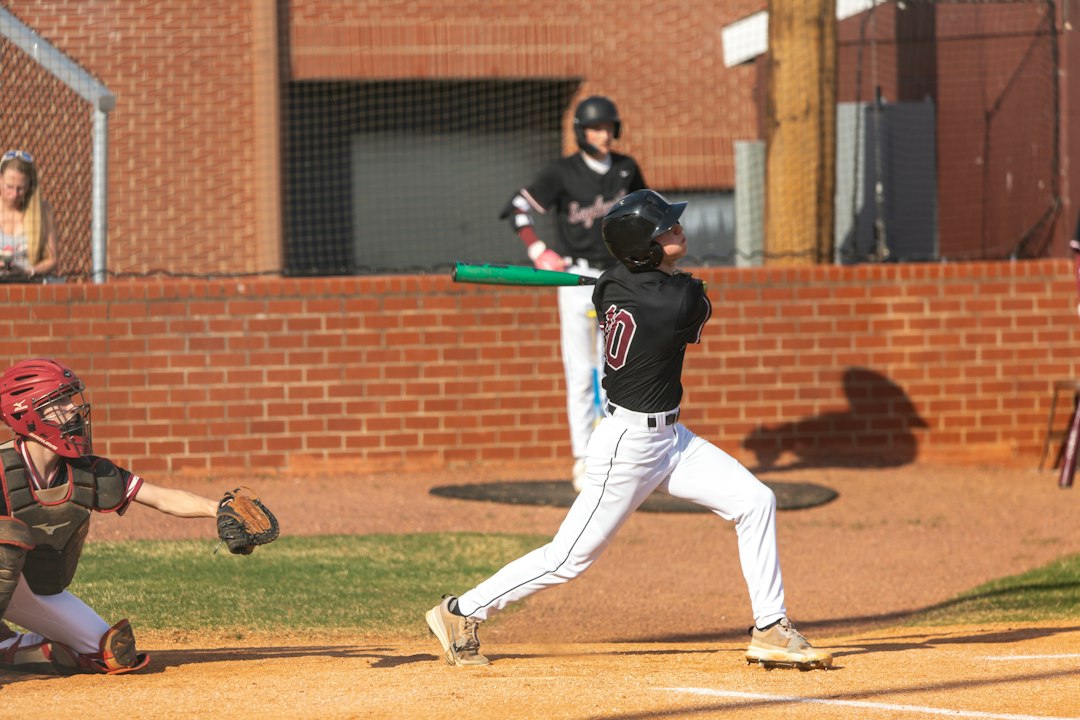




A particular kind of silence settles over a school bus the moment it turns out of your own parking lot and heads toward someone else's town.
It isn't nervous quiet. It isn't the silence before a locker room speech. It's something harder to name — a collective awareness that the familiar is falling away behind you, and whatever comes next, you're going to have to handle it without the usual support structure holding you up.
The experience of away games in high school baseball carries that feeling all the way through. It doesn't fully resolve until years later — until you're in an unfamiliar city for a job interview, or walking into a meeting where the room's energy is clearly aligned against you, or navigating a situation where nobody in the building knows your name. And something underneath the nerves says: I've done something like this before. I know how to be here.
That's the piece nobody includes in the pregame talk. The away game is teaching you something that has nothing to do with baseball. It's teaching you how to function when the environment isn't built for you.
When the Dugout Belongs to Someone Else
The home dugout is a specific, earned comfort. You know which corner gets the equipment bag. You know which bench plank has the splinter to avoid. You know the sight lines — the way late afternoon light crosses the pitcher's mound at a certain angle, the distance from the on-deck circle that gives you exactly enough room for your pre-at-bat routine.
None of it exists at an away field.
The visiting dugout is always slightly off. The bench runs longer or shorter than you expect. The chain-link is a different gauge. The dirt under your cleats packs differently — harder, or looser, or with a different give that registers in the soles of your feet before your brain processes it. Even the smell is wrong. Different clay, different infield grass, different concession stand output drifting in from a direction that keeps catching you off guard.


And then there's the crowd.
At home, the stands are an extension of the team. A wild pitch, and the people who know your name groan in sympathy. A line drive into the gap, and you can hear your parents' voices before you've even finished rounding first. The home crowd functions as an invisible twelfth player who never throws an error and shows up for every at-bat.
At a rival school, that twelfth player belongs to the other team — and they've been preparing since the schedule dropped.
They cheer the errors. They go deliberately quiet on a great play, which is its own kind of noise. They have inside jokes about your school that land in the dugout like they were aimed there. They are not trying to rattle you as an individual. You are simply the opposing jersey today, and they are doing what crowds do when the opposing jersey shows up.
Learning to compete inside that hostility — not to mute it, which is neurologically impossible, but to operate within it — turns out to be one of the more underrated lessons a high school player receives. The technique isn't suppression. It's inclusion. You hear it, you register it as neutral information, and you take your stance anyway.
That skill travels.
The Road Trip With Teammates Builds Something That Practice Can't
There is a specific version of team chemistry that only gets constructed on a bus.
In our experience covering high school baseball culture and gathering stories from former players about what stayed with them into adulthood, the road trip itself — not the game, but the getting there — surfaces more reliably than almost anything else. The forty minutes before arrival, when the cooler has been packed and someone's older sister contributed a box of granola bars and the aux cord argument has been going for fifteen minutes without resolution. That specific unrepeatable combination of people going somewhere together to do something that matters.
Jordan M., 28, a former shortstop from central Ohio, described an away loss in a story submission that stuck with us: "We lost 7-2 and I genuinely can't tell you my specific at-bats anymore. What I remember is Tyler falling asleep on my shoulder on the way back and nobody waking him up because we all felt the same way. Just done. Together."
That isn't a baseball memory. It's a human one — and it happened because the road trip stripped away everything except the people.
The bus ride does something to a group of young athletes that home games and practice schedules can't produce. It removes the familiar scaffolding — parents in the bleachers, coaches twenty feet away in their offices, the water fountain you've used two hundred times — and leaves players with only each other and whatever they've built together. What that group has actually developed in the weight room, the batting cages, the infield repetitions — all of it gets tested against an environment that has no interest in confirming it.
Whatever survives that test is real chemistry. The rest gets sorted out somewhere on the highway home.
What the Hostile Fans Environment Is Actually Teaching
The boo is an education. Not a metaphor for one — the actual thing.
Being jeered by strangers who know nothing about you beyond the number on your jersey delivers a lesson that very few adolescent experiences can match for clarity: other people's responses to you are frequently not about you at all.
The hostile crowd at a rival school is a near-perfect environment to learn this. They are not reacting to your actual performance history, your work ethic, your character, the extra hour you put in last Tuesday working on your footwork. They are reacting to what you represent — the opponent, the threat to their team's record, the disruption of the expected outcome. You are a symbol wearing cleats. They do not know you. They know your jersey.
Playing through that — not past it, but through it — teaches something that transfers into almost every demanding adult situation: the ability to distinguish between what the room is doing and what the room knows about you.
The American Psychological Association's framework on adolescent resilience identifies manageable adversity — challenge that is genuinely difficult but not overwhelming — as one of the central mechanisms through which young people build the psychological flexibility to handle adult stress. The away game, at its functional best, is exactly that structure. The stakes are real. The environment is genuinely working against you. But the player has preparation, teammates, coaching, and demonstrated capability. The crowd's hostility doesn't determine the outcome. It just requires more from you to achieve it.
That's the definition of a useful teacher. It raises the requirement. It doesn't change the answer.
The Honest Accounting of What Home Field Was Giving You
Looking back at the comforts of home field through something clearer than nostalgia, a more complicated picture comes into focus.
Home field gave you certainty. And certainty is a remarkable resource when you're seventeen and still calibrating the mechanics of your swing and genuinely unsure whether your off-speed pitch is doing what you think it's doing. The familiar dugout, the crowd that tracks your name, the chalk lines drawn by a grounds crew that's watched you develop since your sophomore year — all of it reduced the variables. The only unknown at home was the game itself.
That's a genuine gift. Gifts carry shadow sides.
Players whose schedules leaned heavily toward home games and away from the hostile road trips sometimes arrived at travel ball tryouts or college programs with a capability gap that had nothing to do with mechanics. Not talent. Not preparation. The specific self-generated steadiness that comes from having already been in environments where nothing was arranged for your benefit — and having competed well anyway.
Two things the home field provided freely that the away game teaches you to carry yourself:
- Confidence that doesn't require crowd confirmation. At home, the response to a good play is immediate and warm. On the road, you learn to carry an internal acknowledgment of the right decision before external confirmation arrives — or doesn't. You know the throw was right before the umpire signals anything.
- Focus that doesn't depend on quiet. Home crowds tend toward silence during opposing at-bats. Hostile crowds do the reverse deliberately. Finding your focal point inside that noise — learning to locate your mechanics and your reads inside an environment that is actively trying to disrupt them — is a skill that transfers into loud offices, difficult conversations, and any room where the ambient pressure is working against your best thinking.
The away game delivered both of those by making you need them before you knew you were building them.
The Bus Ride Home Is Its Own Kind of Chapter
Win or lose, the bus ride back carries a different quality than the ride out.
On the way there, everything is still open. The outcome hasn't happened. The playlist argument matters because the mood matters because the game hasn't started. On the way home, something has been decided. The scoreboard said what it said, and now everyone on the bus is sitting with what that means.
A win at a hostile field — executing under conditions designed to make execution harder, delivering the key moment in the environment least arranged for your success — produces a bus ride home that is quieter than you'd expect and more satisfying than almost any home win reaches. It's a different frequency of satisfaction. Something earned in a harder place.
A loss produces something else. Not devastation, if the team culture is sound — something more productive than that. A shared space to sit with a difficult result without the immediate softening of parental comfort or the escape of your own bedroom and your own things. Just the road going past the windows and the people next to you who also competed and also came up short and are also figuring out what to do with that.
Four things that happen on that ride home that don't happen anywhere else in a player's week:
- Unfiltered self-assessment, removed from coaching instruction and parental optimism
- Genuine peer processing — what broke down, who steadied things, who needs a quiet word
- Physical exhaustion that lowers defenses and allows honest conversation to happen without anyone engineering it
- The first quiet practice of talking about a hard thing with people who were actually there
Those accumulated hours across a season of road games are, in retrospect, some of the most concentrated character-development time a young athlete gets. Nobody scheduled them as growth opportunities. They're simply the unavoidable result of going somewhere difficult together and making the drive back.
What You Actually Carried Home From the Road
The honest accounting of away-game statistics may not show a player's best numbers. The conditions weren't arranged for best numbers. The opposing pitcher had every advantage the home field extends — the familiar rubber, the sight lines he's used two hundred times, the crowd as his twelfth player. You were the visitor in every dimension the word carries.
But the player who stepped off that bus after the final away game of the season wasn't the same player who boarded it in September.
Something happens when a young athlete stands in a hostile batter's box — crowd noise deliberately aimed at disruption, teammates watching from a dugout that smells like someone else's season — and finds the stance anyway. Loads correctly anyway. Reads the pitch anyway. Competes anyway. It builds something in the foundation beneath a player's sense of self that comfortable home-field seasons simply don't reach.
It says something at a level below conscious thought: I can do this when nothing has been set up for me. I have already done it. That is now part of what I know about myself.
That piece of self-knowledge, built across a high school career's worth of road games against hostile crowds in unfamiliar towns, becomes part of how a person navigates the world long after the cleats go into storage. The first apartment in a city where they don't know anyone. The presentation to a room that arrived skeptical. The project that requires performing well in an environment that isn't offering any of the usual support.
The away game already ran that training. The player just didn't have language for it yet.
Your jersey is still out there waiting.
Design yours in minutes and see your name and number exactly the way you remember it — a tribute to the uniform from the bus rides, the hostile fields, and the dugout that smelled like someone else's season.
Frequently Asked Questions
What makes the experience of away games in high school so memorable compared to home games?
Away games remove the familiar infrastructure — the home crowd, the known field, the comfortable pregame routine — and leave players with only their preparation and their teammates. Experiences that require greater effort to navigate tend to encode more deeply in memory. A player who delivered a key moment at a hostile away field often recalls it more clearly decades later than a statistically stronger home game performance, because the conditions surrounding it demanded more from them.
How did playing at a rival school prepare athletes for challenges later in life?
The rival school environment requires a young athlete to perform under conditions explicitly not arranged for their success — unfamiliar surroundings, a crowd working against them, and the pressure of competing without home-field support. Those are the same conditions that characterize many adult professional and personal challenges: unfamiliar organizations, new cities, rooms where the ambient energy is running against your position. Players who accumulated road-game experience developed a self-reliance that doesn't depend on external confirmation — and carried it forward.
Is the road trip with teammates actually important, or is it mostly nostalgia talking?
Both things are true simultaneously. The road trip generates genuine bonding that home-game routines don't produce, because it removes players from their individual comfort systems and places them in a shared, slightly uncomfortable situation where mutual reliance becomes necessary rather than optional. Research on adolescent social development consistently identifies shared challenge as among the most effective bonding mechanisms available to young people. The nostalgia is real, but it's tracking something that was actually real underneath it.
What should coaches know about preparing players for a hostile fans environment?
The most effective preparation is honest framing rather than dismissal. Coaching players to simply ignore the crowd sets up an impossible task — the auditory system has no voluntary mute. More effective is teaching players to include crowd noise as neutral environmental information: sound that is present, that requires no response, and that doesn't change the mechanics of the next pitch or the reads of the next at-bat. Players who learn to hear hostility without reacting to it develop a concentration under pressure that transfers well beyond the baseball field.
See also: the bus ride home after a loss | what high school sports actually teach you | why high school sports still matter to adults | playing under the lights on a Friday night | why your senior season memories are so vivid