

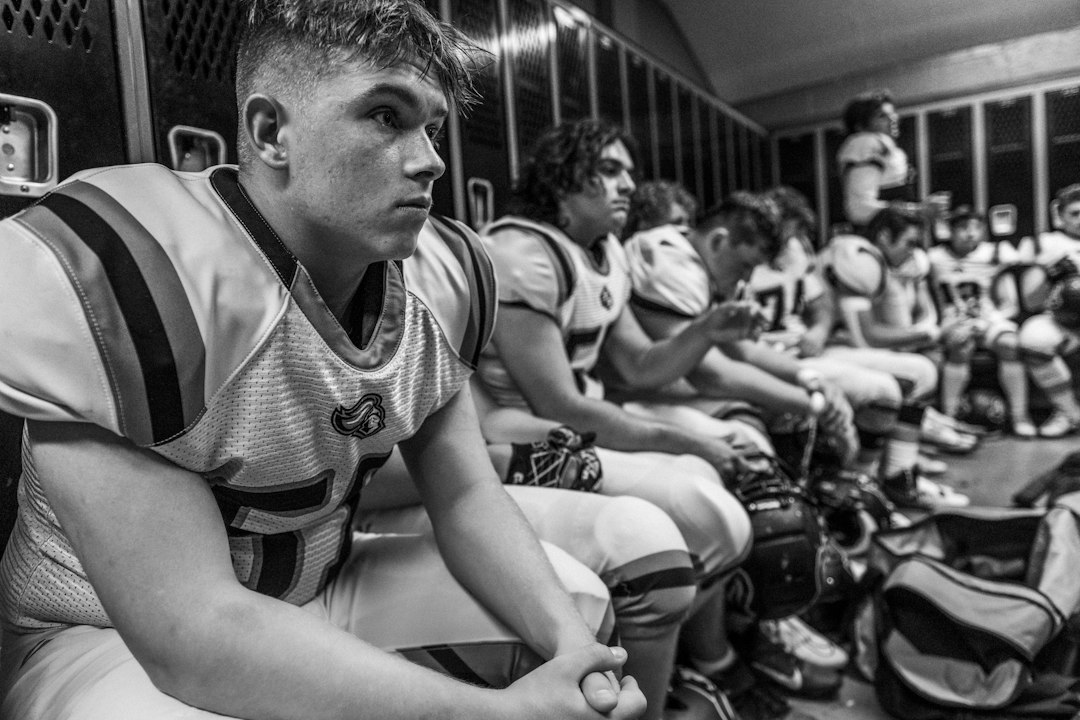




Some quiet has nothing to do with the absence of sound.
The locker room silence before a football game is its own specific thing — pressurized, shared, earned. It settles into a room full of players somewhere in that final 40 minutes before kickoff, and it does not feel like emptiness. It feels like a room holding its breath on purpose. If you have stood inside it even once, you know exactly what this article is about before you read another sentence.
This one is written for you.
What the Football Pregame Locker Room Actually Feels Like
Step into any high school football pregame locker room in that last half-hour and the first thing you register — the thing that stops people who have never played — is that it is quiet. Not library quiet. Not the passive quiet of an empty hallway. The kind of quiet where the sound of a roll of athletic tape being torn cuts clean across the room.
Everywhere you look there is activity. Shoulder pads being seated into place. The scrape of cleats on painted concrete. The layered smell of analgesic ointment and old rubber and the specific sharpness of nervous sweat sitting just underneath deodorant and whatever someone sprayed too much of an hour ago. Motion in every corner.
And yet — silence.
A player at the far end of the bench stares at a point on the floor that has nothing on it. Someone two lockers over has headphones in; you catch the faintest suggestion of percussion, just enough to know they are using it to stay inside themselves. The starting left guard is working through the same pre-wrap sequence he has used since his first varsity game — right ankle before left, three loops, two clean tears — and he has not looked up once since he sat down.
This is the football pregame locker room. To anyone who has never dressed out for a Friday night, it reads like a room full of people waiting for something they are dreading.


What it actually is takes more words than that.
The Silence in the Locker Room Is Not Emptiness — It Is Preparation Made Visible
The image most people carry of pregame energy is built from highlights: music at full volume, voices loud, bodies in motion, somebody bouncing on the balls of their feet for no reason except that stillness has become impossible. That is what gets shown — kinetic, performed, directed outward at an audience. The NBA tunnel walk. The playoff dugout. Energy as spectacle.
The locker room silence before a football game runs in the opposite direction.
It is what emerges when a group of people reach a collective, unspoken agreement that what is coming is serious enough to require going inward rather than outward. Each player withdraws into themselves. The room becomes a space where dozens of private rituals happen in public, side by side, without interference. The silence is the container. It holds all of it.
There are sports where pregame is almost entirely about elevation — ascending in energy, minute by minute, until the opening whistle. Football reaches that too. But it passes through this first. The descent before the ascent. The compression before the release.
In our experience covering high school football across multiple seasons, the moments players return to years later are almost never specific plays. They are these moments — the locker room before the first road game, the quiet before a rivalry matchup the whole town has been building toward for two weeks, the season the team went undefeated through October and nobody said a word for the final fifteen minutes before they ran out.
The game starts in that room. The field is just where it becomes visible.
The Locker Room Silence Before a Football Game: Why This Sport Specifically
The character of that silence is not accidental. It is produced by a set of conditions that exist in football and not, in the same combination, anywhere else.
The physical cost is known and embodied. A basketball player heading onto the court understands that contact is part of the game. A football player walking toward that field carries in their muscles and their memory the specific sensation of what a hit at game speed feels like — not as an abstraction but as a physical record. The silence holds that knowledge. The body is already rehearsing.
The preparation cycle arrives fully loaded. Football game weeks have a shape. Film on Monday. Installation Tuesday and Wednesday. Walkthrough Thursday. By the time a player is sitting in that locker room, they have spent five consecutive days living inside the same game plan. They know the opposing safety's tendencies, the way the other team's center telegraphs a shotgun snap. There is nothing left to process. The silence is a system that has been fully loaded and is now simply waiting to run.
Suiting up is a genuine transition, not a routine. The process of putting on full football equipment takes long enough to function as ritual. A player who arrives in street clothes and stands forty minutes later with pads locked in and chinstrap snapped has moved through a layered physical transformation. The room gets quieter as more players complete it, because each one crosses from one state into another and brings the stillness of that crossing with them.
Proximity amplifies everything. Forty to sixty players share a space built for considerably fewer. Shoulders are close. The collective decision to honor the silence — to go inward together — is a genuinely communal act. Each person's stillness is felt by the people around them. That shared stillness compounds.
This is football's specific psychology making itself legible inside a specific room.
The Last-Minute Talk Before the Football Game
Then the coach speaks.
Somewhere in that final ten minutes, the head coach calls the room in. This moment is worth examining separately from the silence that preceded it, because the last-minute talk before a football game is one of the most misrepresented things in the sport.
What film has trained us to expect: the crescendo speech, the perfectly deployed historical reference, the voice that breaks at exactly the right moment and makes a room full of players decide collectively to do something they were not sure they could do. That version exists. It happens. But it is not what the moment is fundamentally for.
The coach's speech before the game — the real one — does something more specific: it names the room.
It acknowledges what has been accumulating in the silence. Without always saying it in those words, it tells the team: I see what you have built in here tonight. I see that the room is ready.
The best pregame talks in high school football are not the loudest ones. They are the ones that arrive at exactly the frequency the room is already vibrating on. A skilled coach reads whether his team needs to be lifted from a flat place or whether they are already precisely where they need to be and what they require is simply permission to leave. The coach's speech before the game is calibration. It is not cold ignition.
What players carry with them years later is almost never the words. It is the sensation — a room that had been holding something together through sheer collective will, through the silence in the locker room and all the private preparation it contained, and then being recognized by the one person with the authority to say: this is real, this matters, now go.
Marcus T., 34 — The Game He Still Talks About
Marcus T. played right guard for a mid-sized program in rural Ohio. He was not a starter until his junior year, and he is honest about where he stood on those teams — good enough to dress every Friday, not prominent enough to draw recruiting attention. But there is one game he describes with the kind of precision most people reserve for events that redrew a boundary in their lives.
"We were playing our rival and we had lost to them three years in a row," he said. "I remember sitting in that locker room and nobody said anything for so long I started thinking something was actually wrong. Then I looked around and realized — everyone had the same look. We were all exactly in the same place. When Coach came in he didn't yell, didn't do any of the movie stuff. He looked around the room slowly and said: 'The room is ready.' That was the whole speech."
They won by 14. Marcus says he barely remembers the scoring plays. He remembers the locker room.
The Rituals Inside the Silence
The quiet in that room is not uniform. It is layered with individual ritual — and those rituals are part of what keeps the experience communal rather than simply solitary.
Move through the room in that final half-hour and you will find:
- The player with headphones who has not changed position in fifteen minutes, eyes closed, jaw set, present somewhere that is not in this building
- The lineman taping his wrists in an exact sequence he has followed since his first varsity start — a practice he would not call superstition, because that word implies it is optional
- Two teammates sitting with their shoulders touching in a way that is clearly deliberate, not accidental proximity — neither of them speaking, both of them steadied by the contact
- The kid who crosses himself quietly, twice, then looks at the floor
And moving through all of it: the captain. Drifting slowly through the room, making brief eye contact with specific people, not speaking. Just checking in. Doing more relational work than anyone else in the room without producing a single audible word.
None of these rituals were designed. They accumulated — built up over weeks and seasons by players who kept returning to the same room to prepare for the same kind of demand. What unifies all of them, what keeps the room feeling like one thing rather than sixty separate private experiences, is a shared and entirely wordless understanding: this silence belongs to everyone in here, and it is not yours to break without purpose.
That understanding is never posted on a wall. It does not need to be.
Why This Silence Stays With Players for the Rest of Their Lives
Talk to players who are five, ten, twenty years past their last Friday night, and something specific happens when you turn the conversation toward those years. They do not reach first for plays.
They go back to that room.
The catches blur with time. Final scores require a beat to retrieve. But the texture of the football pregame locker room — the smell, the specific weight of pads fully locked in, the sound of the last piece of tape being torn — holds with unusual clarity for decades.
There is a reason. What happens in that locker room before a football game is one of the rare experiences of genuine collective psychological preparation that most people will not encounter again once high school ends. Adult life rarely produces it. The focused stillness of a room full of people preparing together for something that is genuinely demanding — in the way that sharpens rather than paralyzes — is an uncommon human experience, and the brain treats uncommon things accordingly.
Research on autobiographical memory consistently finds that emotionally saturated, socially meaningful, sensorially specific experiences form some of the most durable long-term memories we carry. The locker room silence before a football game delivers all three in concentrated form. Often more intensely than the game that follows it.
The score fades. The room stays.
What That Silence Was Actually Telling You
Here is what is hardest to articulate in the moment and clearest in hindsight:
The silence was not an absence. It was an accumulation.
It was the compressed weight of everything the team had put in — every two-a-day session in August, every film review that ran long, every Thursday walkthrough in October rain. All of that preparation, stored in the bodies of forty players sitting together in a room, is what produced that specific quality of quiet. You cannot perform it. You cannot schedule it. It arrives on its own when a group of people have done enough real work together that they no longer need to demonstrate their readiness to each other.
That is what made it feel like something worth protecting. Not ceremony — but the specific gravity that settles over a room when people who have genuinely earned something are about to find out if they earned enough.
The coach's speech before the game was not where that began. The silence was. The speech was simply the door.
Your jersey is still out there waiting.
Design yours in minutes and see your name and number exactly the way you remember it — a tribute to the team, the season, and the room you stood in before the lights came on.
Frequently Asked Questions
Why is the locker room so quiet before a football game?
The locker room silence before a football game emerges from a specific convergence of factors: a full week of mental preparation that has reached saturation by Friday night, the embodied physical memory of what game-speed contact feels like, the gradual psychological transition of suiting up in full equipment, and the compressed proximity of a large team sharing a small space. Each element reinforces the others. The quiet is not imposed by rule or tradition — it arrives on its own when a group of fully prepared people collectively decide, without a word, that this moment is serious enough to require going inward.
What makes a good coach's speech before a football game?
The most effective pregame talks in high school football are rarely the loudest ones. A good coach reads the room before speaking — assessing whether the team needs elevation from a flat place or simply permission to leave a place they have already reached. The talk's real function is to name and validate what the team has built in the silence, and to authorize the transition from preparation to action. Players rarely carry specific words from even their most memorable pregame speeches. What stays is the feeling of being seen, recognized, and released.
Why do so many players remember the locker room more clearly than the game itself?
Games are fast, fragmented, and largely processed in a reactive state. The pregame locker room is slow, emotionally saturated, and highly conscious — players are fully present in a way that competitive action rarely allows. Memory research consistently shows that the brain preserves experiences with high emotional intensity, social meaning, and sensory specificity. The football pregame locker room delivers all three simultaneously, and often more intensely than the game that follows. The final score fades with time. The room holds.
Is this kind of pregame stillness unique to football?
Individual sports like wrestling and cross country carry their own versions of internal pregame stillness, shaped by stakes that are entirely personal. But the specific character of football's locker room silence is produced by a combination that does not exist elsewhere in the same form: the layered physical process of suiting up, the team size packed into shared space, the embodied memory of contact, and a week-long preparation cycle that arrives fully loaded on game night. Players who have competed across multiple sports consistently describe the football pregame locker room as categorically different — not better or worse than other sports, but its own distinct and unrepeatable thing.
What happens when someone breaks the silence in a football locker room before a game?
The room corrects it without words. The visible stillness of everyone else, the absence of response, the collective attention that suddenly has nowhere to go — these make a disruption land with more weight than it would in any other setting. Players learn quickly, usually without being told explicitly, that the pregame silence belongs to the team as a whole. Honoring it is an act of belonging. Breaking it without purpose is a social mistake the room registers immediately. That understanding is part of what transforms a group of individuals who wear the same colors into something that functions as a single unit.
See also: why those pre-game memories are so vivid decades later | the shared rituals that only teammates truly understand | what playing under the Friday night lights actually felt like