

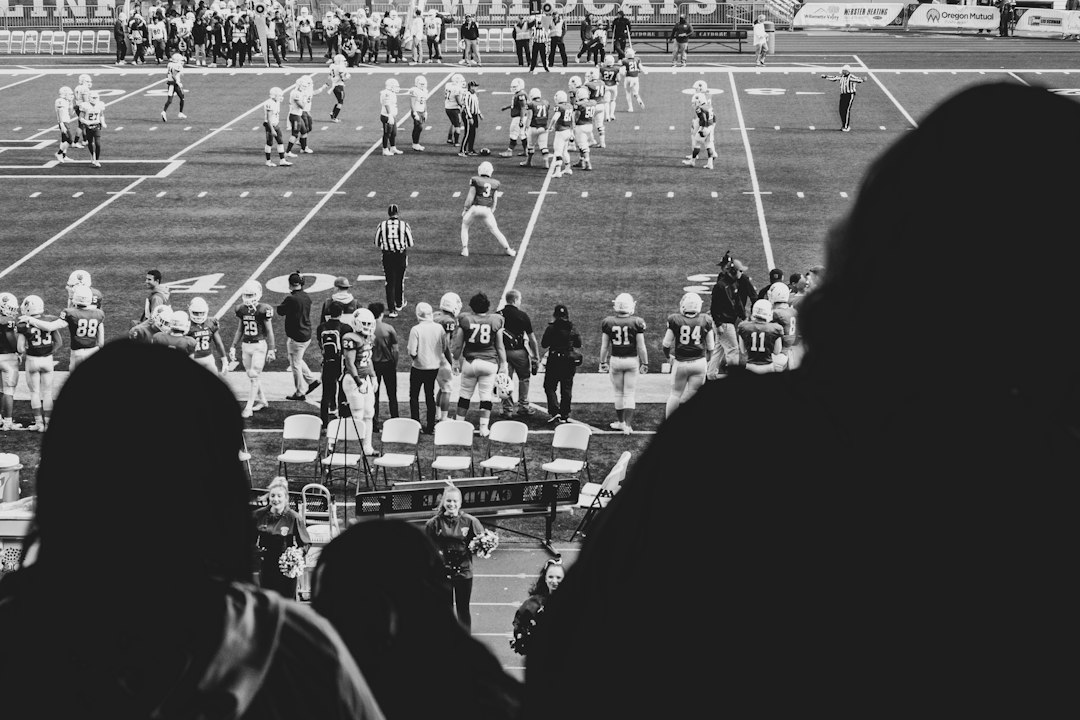




The smell hit you before the lights did.
Popcorn and cold air and something electric that you couldn't name but would recognize forever — that specific Friday night combination that existed nowhere else in the world except a small town football field in the fall. The kind of smell that, decades later, catches you sideways at a county fair or a Little League game and pulls you back so completely it takes a second to remember where you actually are.
Small town Friday night football wasn't a sporting event. It was a community exhaling together — one night a week when every hardware store owner, every schoolteacher, every grandmother who barely knew the rules of the game put on a jacket and drove to the same field because that's what you did. Because someone they knew was under those lights. And that someone, most nights, was you.
If you played, you know exactly what that felt like. And if you're honest with yourself, you've spent at least a few quiet moments since then wondering why nothing has quite matched it.
The Lights Were the First Signal That This Night Was Different
There is a specific moment that every player who suited up for a small town high school game carries. It happens at the end of warm-ups, when you jog back toward the sideline and look up — really look up — at the stadium lights blazing against a dark sky. The sky is navy. The field is impossibly green. And the stands are filling with people who drove here specifically because you are playing tonight.
That moment does something to a person. It did something to you.
It wasn't ego, exactly. It was more like confirmation — the feeling of arriving at a place you were always supposed to be. The lights said: this matters. The crowd said: you matter. And in a small town, where you knew every face in those bleachers and they knew yours, the weight of that combination was something no stadium three times the size could have delivered in the same way.


Big-city high school football has spectators. Small town Friday night football had witnesses.
The people in those wooden bleachers or folding chairs they dragged from their trucks weren't watching a performance. They were watching someone they had watched grow up. The woman in row four had seen you learning to ride a bike. The man near the fence had coached your first baseball team when you were seven. The kids pressed against the chain-link on the visitor's side had no particular loyalty to either team — they were just there because on a Friday night in a small town, this was the center of the universe.
And for a few hours every week in the fall, it genuinely was.
What Community Witness Does to a Young Athlete
There is something that happens to a person when they perform in front of people who have a genuine stake in them — not in the outcome of the game, but in them. In whether they're okay. In whether they give everything they have. In whether they come off that field standing upright.
This is the thing that's hard to explain to someone who grew up in a city where their games drew forty people from their own family and a handful of distracted strangers. In a small town, the crowd was not neutral. They were invested in a way that went years deep.
Your coaches' families were there. Your teachers were there. The pastor from whatever church your family attended was likely there. The woman who had given you a job mowing her yard was there. The whole machinery of your daily life came to watch on Friday nights, and that created a particular kind of pressure — but also a particular kind of support — that forged something lasting in a person.
Every former athlete remembers the specific face they found in the stands when something hard happened on the field. A fumble. A bad snap. A hit that took the wind out of you and left you on the turf for a moment too long. And every former athlete remembers who was still standing, still clapping, still there when you got up.
That is not a small thing. That is a formative thing.
Marcus T., 44, grew up playing linebacker for a 400-student school in rural Tennessee. He still talks about the night he blew a coverage assignment in the fourth quarter of a rivalry game — a mistake that cost them eight yards and very nearly cost them the win. After the game, standing outside the locker room, four different adults from his community tracked him down. Not to critique the play. To tell him he'd played his heart out and they were proud of him. "It's the only time I can remember a loss not feeling like a failure," he says. "Because the people who mattered most weren't tracking the scoreboard the same way I was."
Small Town Friday Night Football and the Ritual That Surrounded It
The game itself was almost beside the point. Not because winning didn't matter — it absolutely did, and anyone who tells you differently didn't play — but because the ritual surrounding the game was doing its own separate, significant work on everyone involved.
The bus ride to away games. The specific way the locker room smelled before kickoff. The warm-up playlist someone's older brother had burned onto a CD and left in the team's possession. The coaches' pre-game speech that you could probably still deliver from memory if someone asked you to.
And then the community side of the ritual:
- The pep rally that pulled the whole school into the gymnasium on Friday afternoons
- The way the game-day jersey changed how people talked to you in the hallways
- The diner downtown that always seemed to have your team's colors in the window somehow
- The specific route the team bus took through town before home games, slow enough that people on the sidewalk could wave
None of this was accidental. All of it was the town building a container for something important — the particular passage of a young person learning what they were made of, with their whole community as witnesses.
The home games had a rhythm you could feel even as a player. By the second quarter, the whole thing had its own momentum that had nothing to do with the score. The crowd would surge and settle. The student section would start something that the adults eventually joined. The chain-link would rattle. And you, down on the field, could feel the whole thing as a physical force at your back — not noise exactly, but will. The collective will of a few hundred people who had shown up for you.
That force is what a lot of former athletes describe as the single most irreplaceable quality of small-town football. The intimacy of it. The specificity of the support. When the whole town is small enough that everyone in those bleachers has a name and a face and a history with the person wearing your number, the support arrives differently than it does from a crowd of strangers.
It arrives as love. The loud, imperfect, Friday night kind.
According to research on adolescent development and community belonging from the American Psychological Association, consistent social support from known community members during formative years is one of the strongest predictors of resilience and long-term psychological wellbeing. Former small town athletes didn't need a study to tell them that. They already knew it in their bones.
If You Played, You Carry Something Others Don't
Here is what's true: the former athlete who suited up under those lights carries a specific kind of formation inside them that is different from someone who was in the stands, different from someone who wasn't there at all, and different even from athletes who played in environments where the community connection was thinner.
You learned how to perform when the stakes felt real and personal. Not just "lose the game" real — but "these people drove here and they know my name and they're watching every play" real. That specific kind of pressure, over the course of a season, over the course of several seasons, builds something durable.
It builds the capacity to show up when it matters. To not shrink from being seen. To understand that effort — visible and genuine effort — is something a community can recognize and honor even when the result doesn't go the way you wanted.
These are not football skills. These are life skills that football, in a specific small-town Friday night context, was the vehicle for delivering.
The person who learned to get up off that turf in front of the whole town — who learned to absorb a failure in full public view and still line up for the next play — that person carries something in them that no other educational experience quite provides in the same form.
In our experience talking with former athletes, it's this dimension of the small town game — the public nature of learning to fail and recover, witnessed by people who genuinely cared — that players cite most consistently when they talk about what football gave them beyond football.
The Bleachers Hold More Than a Memory
There's a reason these Friday nights have such unusual staying power in the former athlete's memory. It's not just nostalgia for youth, though that's part of it. It's not just nostalgia for competition, though that's real too.
It's the specific experience of being held by a community at a moment in life when you were still becoming who you were going to be.
Adolescence is, almost by definition, the experience of not yet knowing who you are. Small town Friday night football gave you, for a few hours every week in the fall, a temporary and specific answer to that question. Under those lights, in that uniform, with those people watching — you knew exactly who you were and where you belonged. The question that keeps most teenagers awake at night was, for those few hours, fully answered.
That is an extraordinary gift. Most people spend years reaching for it in various forms — the job that gives them that feeling, the team at work that echoes that dynamic, the relationship that offers that quality of being genuinely witnessed.
A few find it. Most find something in the neighborhood of it.
But the original — the first time you looked up at those lights and understood that everyone in those bleachers was there for you — that one lives in you permanently. Not as a wound and not as a comparison point against which everything else falls short. As a marker. A proof of concept. Evidence that the feeling of truly belonging to something and being seen by people who know you is a real thing that actually exists in the world.
You didn't imagine it. You lived it.
What Those Friday Nights Still Mean Now
The lights go off. The season ends. And eventually — the way everything eventually does — you stop suiting up and start watching from the other side of the fence.
But the formation is already done.
The person who played small town Friday night football — who showed up every week knowing the whole community was watching, who learned to perform and fail and recover in full public view, who understood what it felt like to have a community genuinely invested in them — that person carries the shape of those Friday nights forward into everything that comes after.
You see it in how former small town athletes talk about the importance of community. In the ones who end up coaching because they can't quite leave that field for good. In the ones who drive back for homecoming games years later and find themselves standing at the chain-link with something almost like relief — it's still here, it still happens, the lights still come on.
The specific character that small town Friday night football built in a generation of young people — the capacity for public effort, the tolerance for failure in front of witnesses, the bone-deep understanding that community support is real and worth showing up for — that character is not confined to the field.
It goes with you.
It's in the way you compete, the way you recover, the way you show up for people who are watching. It's in the specific quiet confidence of someone who was once held by a whole town under stadium lights and learned, in that specific crucible, that they could handle what was asked of them.
That's what the whole community came out to watch on those Friday nights. Not a game. A person becoming.
And that person became you.
Your jersey is still out there waiting.
Design yours in minutes and see your name and number exactly the way you remember it.
Frequently Asked Questions
What made small town Friday night football different from playing in a bigger city?
The scale of community investment. In a small town, the people in those bleachers weren't strangers — they were your neighbors, your teachers, the adults who had watched you grow up. That specificity of witness changes the nature of the experience entirely. Big-city programs can produce elite athletes, but the particular formation that happens when an entire close-knit community shows up consistently for a young person is something a larger, more anonymous environment struggles to deliver in the same way. Former small town players consistently describe a quality of support that felt personal — because it was.
Why do so many former athletes feel such a strong pull back to their hometown games?
Because those games were the site of a specific kind of becoming — a period in life when the community was actively, visibly invested in who you were turning into. Returning to the field, even decades later, is a way of reconnecting with both the person you were becoming and the community that witnessed it. It's not pure nostalgia. It's a recognition that something real happened in that place, and places that hold real experiences tend to pull people back. The smell of the concession stand and the sound of the PA system are sensory anchors to some of the most formative experiences a person carries.
How do you explain the significance of small town Friday night football to someone who didn't play?
The closest analogy is any experience where a person performs something that matters, in front of people who know them and genuinely care about them, in a context where failure is real and recovery is public. The game is the container. What's happening inside the container is a young person learning, in real time, with real stakes, what they're made of — and having that learning witnessed and honored by a whole community. People who didn't experience that environment often understand it intellectually, but the felt sense of it — the specific weight of that particular kind of support — is genuinely difficult to access from the outside.
Does the experience of small town football shape people beyond the sport itself?
Consistently, yes. Former players across sports and eras describe the character built in that environment — the capacity to perform under observation, to recover from public failure, to understand community investment as a real and sustaining force — as something that travels with them into every subsequent arena. Careers, relationships, and community involvement all carry the shape of what those Friday nights built. The skills transfer precisely because they were never really about football. Football was the vehicle. The formation was the destination.
See also: what playing under the lights actually felt like | why high school sports still matter to adults | senior night and what your last home game really meant | the most football-crazy states in America | why the science of your senior season memories is so clear