

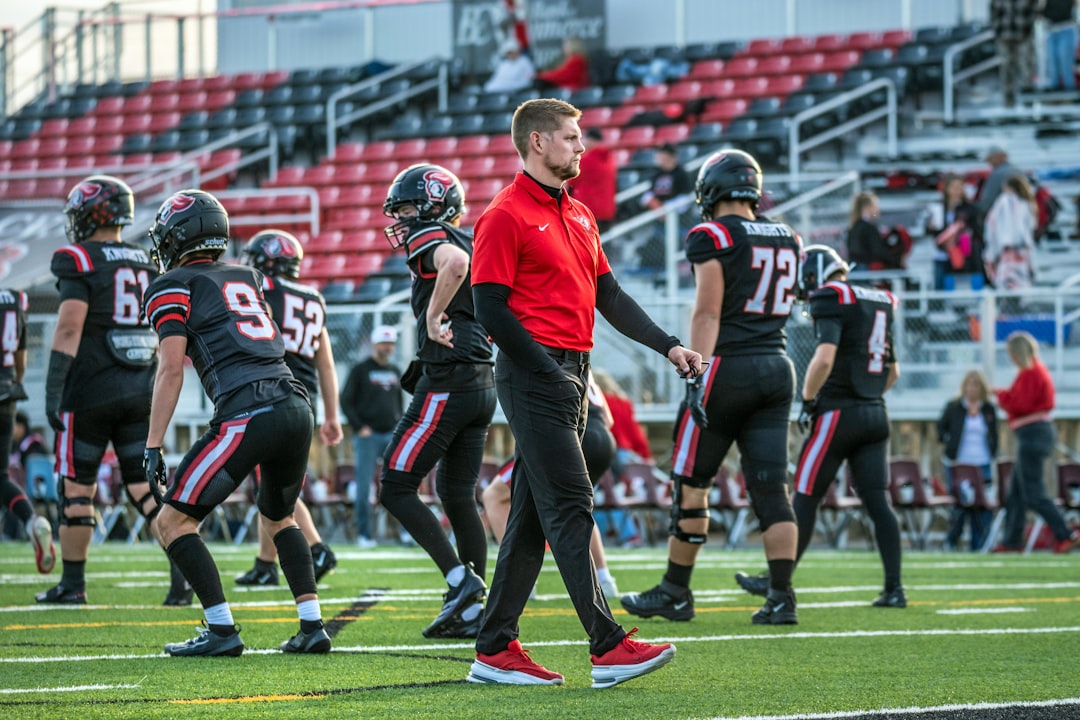




The Los Angeles Rams opened the gates of their High School Coaches Shadow Program — now in its fifth year — to 45 high school and youth football coaches, giving them an unfiltered, inside look at an NFL training camp — how a professional franchise develops players, installs schemes, and runs a practice. The coaches got to observe drills, talk shop with Rams staff, and bring the whole experience back to their programs.
On paper, it's a community outreach story. A nice one.
But for anyone who ever laced up cleats, pulled on a helmet, and lined up under Friday night lights — this one lands somewhere deeper than a press release. Because behind every coach who walked through those gates at Rams Park is a version of the coach who once stood on your sideline. And behind every drill those coaches watched the Rams run is a repetition someone made you do until it was automatic.
This isn't just about football development. It's about the chain.
When Coaches Learn, Players Win — Eventually
Here's the thing about football at the high school level that people who never played sometimes miss: the gap between a good coach and a great one isn't measured in wins and losses. It's measured in the moment a kid realizes he can do something he didn't know he could do.
That moment has a coach behind it. Almost always.
The Rams understood something important when they designed this camp experience — that investing in coaches is the highest-leverage play in youth football development. You don't have to reach every kid directly. You reach the 45 coaches who will each reach 50 kids. You do the math.
Rams running backs coach Ron Gould put it plainly when he spoke to the group: "invest in people."
For anyone who played, the reaction to news like this is immediate and visceral. You don't think about the NFL franchise's community relations strategy. You think about the coach you didn't fully appreciate until years later. You think about the specific voice that called a correction across the practice field at you — not cruelly, but exactly — and how that correction is still living somewhere in your muscle memory.


Great coaching leaves marks. The good kind.
Every Former Player Knows This Feeling
Remember the first time your coach made you do something that felt pointless?
The twelfth repetition of the same footwork drill. The film session where he paused on the same frame four times. The conditioning at the end of practice when you were already running on nothing, and he blew the whistle again.
You thought — at least once — what is the point of this?
And then one Friday night, under the lights, against a defense you hadn't seen before, your feet moved without you deciding to move them. Your eyes found the coverage before your brain processed it. You were already in position before the play developed.
That's what it feels like when coaching works. It doesn't announce itself. It just appears — in the fourth quarter, in the big moment, in the situation where it matters most.
The Rams coaches who opened nine of their training camp practices to 45 high school and youth football coaches this summer were passing something forward. That's the real story here. They were putting into those coaches' hands the same thing a great coach put into yours: a slightly better way to teach someone something that will show up for them when they need it most.
What NFL Practices Actually Look Like — And Why It Matters at Every Level
There's a reason the coaches who got inside access to a Rams training camp will come back to their programs changed.
It's not because the NFL has invented new football. The game is still blocking and tackling, reading keys, understanding leverage and angles. The fundamentals haven't evolved in any radical direction.
What changes at the professional level — what those 45 coaches got to see — is the precision and intentionality behind every minute of practice time. NFL teams don't waste repetitions. Every drill has a purpose that maps to a specific situation that will appear in a game. Every period of practice is designed to create a specific physical or mental adaptation.
High school coaches who get that context don't go home and try to run NFL practices. That's not the takeaway. The takeaway is the thinking behind the structure. When a coach returns to their program having seen how a professional staff decides what gets practiced, how long, at what intensity, and why — their own practice planning gets sharper.
Their players get more out of every repetition.
And some kid — a sophomore who doesn't know it yet — will make a play in a district game two years from now because of a practice drill that his coach designed slightly better after spending a day at Rams Park.
That's the chain.
What This Brings Back for Anyone Who Played
Marcus T., 34, played offensive line at a small high school in central California where the program ran on a shoestring budget and a head coach who drove to clinics on his own dime every off-season. Marcus remembers the year his coach came back from a coaching clinic with a new zone-blocking concept — drew it on a whiteboard before practice, walked them through the footwork slowly, corrected every rep until it clicked.
"We didn't have the athletes other schools had," Marcus told us. "But we ran that scheme better than anyone because Coach had taken the time to actually learn it the right way. We went from losing records to playoffs in one season. Same kids. Better coaching."
That's the version of this story that plays out in towns across the country every time a coach invests in their own development. The Rams' decision to bring high school coaches inside their program isn't a gesture — it's an investment in exactly that kind of chain reaction.
The Sideline Perspective You Never Forget
There is a specific kind of attention that forms in you during your playing days — one that you carry the rest of your life.
Walk past a youth practice at a park on a Saturday morning. You can't not watch for a few seconds. Something pulls. The sound of a coach's whistle. The particular way a kid lines up and then lines up differently after a correction. The small adjustments.
Former players see practices differently than people who never played. We notice when a kid's footwork is wrong before we consciously process what we're looking at. We feel the energy of a practice going well versus one that's just going through motions. We can tell when a coach has a plan.
That's what 45 high school coaches brought with them to the Rams' facility — their own playing days, somewhere underneath the clipboards and headsets. Their own memories of being the kid who got corrected on the twelfth rep of the same drill. Their own experience of what it felt like when a coach cared enough to get the details right.
They walked into that training camp as coaches. But somewhere in there, for a moment, they were players again.
The Ripple Effect You Don't See Coming
Youth football in America is having an interesting moment. Participation numbers at the youth level have required programs to think harder about how they develop players — not just physically, but in terms of skill development and coaching quality. The programs that thrive are almost universally the ones with coaches who keep learning.
The Rams' decision to invest in 45 of those coaches isn't a small thing. Conservatively, each of those coaches works with dozens of players per season. Over a career, a high school football coach might influence hundreds of young athletes — not just in football terms, but in terms of discipline, preparation, how to receive coaching, how to compete.
The ripple goes a long way.
In our experience covering the intersection of sports culture and former-player identity, the moments that matter most in an athlete's development are rarely the biggest games. They're the practices. The corrections. The drills that felt pointless until they didn't.
The Rams gave 45 coaches a few hours inside the machine. What those coaches do with it — what they bring back to their kids — will play out over seasons.
What the Coaches Who Went Home Will Do Differently
The coaches who walked through those Rams practice gates didn't just observe — they absorbed. Here's what typically changes in a coach after an experience like this:
Practice structure gets tighter. When you see how a professional staff allocates time, you return to your own practices with a sharper eye for waste. The drill that runs three minutes too long. The transition between periods that costs ten reps a day across a season.
Player development conversations get more specific. Watching NFL position coaches work with their players — the precision of the language, the specificity of the corrections — raises the standard for how a coach communicates. Vague instruction ("do it better") gets replaced with specific mechanism ("your hips are opening before your hands set, here's the fix").
The belief in player potential gets reinforced. There is something clarifying about watching professional athletes — grown men who have achieved the highest level of the sport — still working on fundamentals with total seriousness. It's a reminder that the work never stops, and that the kid on your roster who seems raw isn't a write-off. He's a project.
That's the mindset that comes home from a day at an NFL training camp.
Your Jersey Is Still Out There Waiting
The coaches who walked through those Rams gates this summer took something home with them — a memory of being close to the game at its highest level. Of standing on a field where the best players in the world run the same drills you once ran, taken further than you could imagine.
If that stirs something in you — if this story brought back your own playing days, your own practices, your own number on the back of a jersey — that feeling is worth honoring.
Design yours in minutes and see your name and number exactly the way you remember it.
Frequently Asked Questions
What was the purpose of the LA Rams' high school coach training camp event?
The Los Angeles Rams invited 45 high school and youth football coaches to their training camp to give them an inside look at NFL-level practice structure, player development methods, and coaching techniques. The goal was to help community coaches improve their programs by seeing professional football operations up close.
How does NFL-level coaching exposure benefit high school football programs?
When high school coaches observe professional practice structure, they return with a clearer sense of how to design purposeful repetitions, communicate more specific corrections to players, and allocate practice time more efficiently. The impact shows up in their players' development over the following seasons — not immediately, but consistently.
Is this kind of NFL outreach to youth coaches common?
Several NFL franchises run some form of community coaching clinic or outreach program, but providing high school coaches full inside access to an active training camp — with observation of drills, positional work, and player development practices — is a more substantive investment than a typical clinic format. The Rams' approach reflects a genuine commitment to the grassroots football ecosystem in their market.
What should former players take from a story like this?
More than anything, it's a reminder of the chain. Every level of the game is connected — from youth leagues to high school to college to the NFL. The coaches who shaped your development were part of that chain. Events like this one strengthen it. For former players, this story is a chance to remember what good coaching felt like from the inside.
See also: what high school sports actually teach you that no classroom can replicate | the most football-obsessed states in America | why high school sports still carry so much weight for the adults who played them