

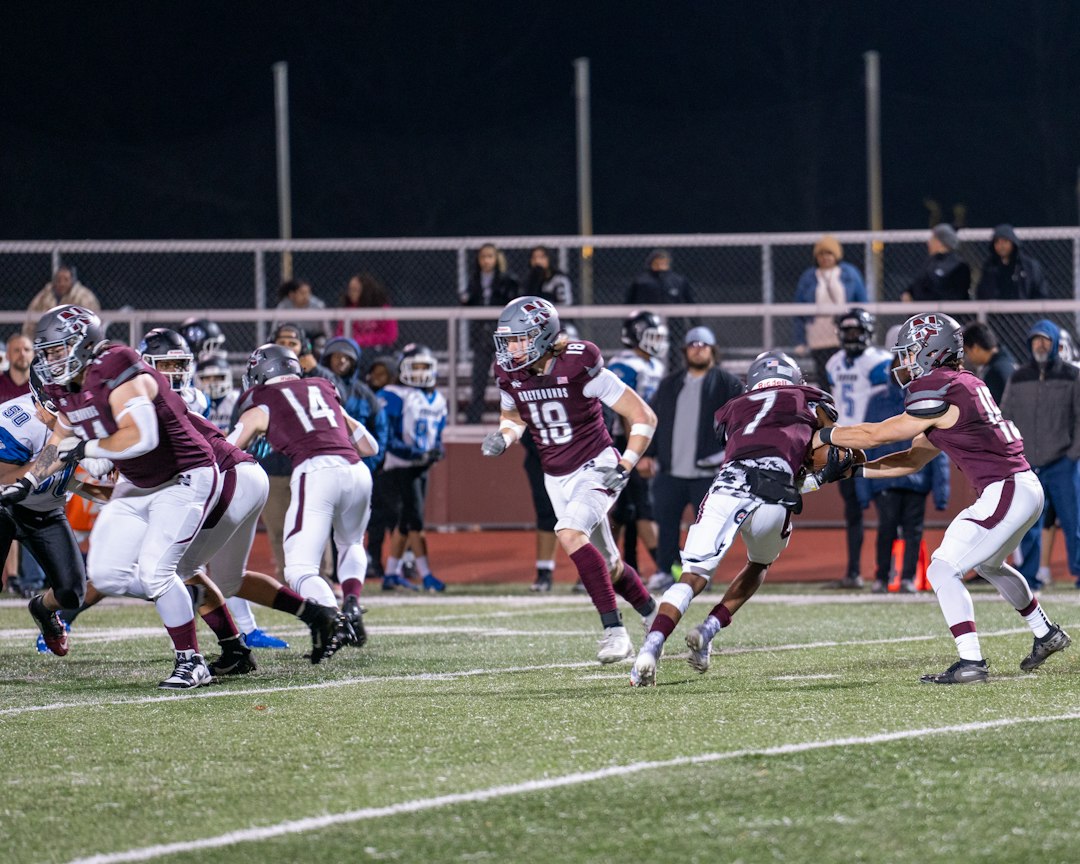




Friday Night Iowa: What This Week's Top 25 Results Mean If You Ever Wore the Helmet is more than a rankings update — it's a dispatch from the exact emotional territory that former players never fully leave behind.
Iowa's high school football Top 25 just completed Week 10 action on October 30, 2026, and the results — programs holding on, others falling, seasons clarifying themselves in real time — are the kind of thing that doesn't stay on a scoreboard. They travel. They reach former players wherever they are on a Friday night, sitting in a living room or a bar or a pickup truck idling in a parking lot near a field they haven't played on in fifteen years. The scoreboard is public. The feeling it triggers is personal.
That's what this is about.
What Week 10 Actually Means for Anyone Who Ever Played
The results from Iowa's Top 25 this week followed the pattern that makes late October football feel like its own separate season inside a season. Ranked programs were tested. Some answered. Some didn't. Teams that spent August and September and the first cold weeks of October building toward something found out, in the space of four quarters, whether what they built was real.
That's week 10. It has always been week 10.
The final score tells you the outcome. It does not tell you about the defensive end who played the second half on one functioning ankle, or the wide receiver who dropped a pass in the third quarter and had to decide — in about four seconds of real time — whether to let it ruin his night or to run the next route like that moment never happened. Scores are documentation. What happens inside a game belongs to the people who were in it.
For anyone who ever put on pads in Iowa — any level, any era, any program — the results from this week land differently than they do for a casual observer. You don't read the outcome. You inhabit it. You know what that locker room sounds like after a win that keeps a playoff run alive. You know what it sounds like after a loss that ends everything.


The winners this week felt something specific: the particular joy of a late-October result that confirms the work was worth it. That joy is almost startling in its intensity. It's not happiness exactly — it's relief and pride and disbelief folded into one physical sensation that comes out as noise.
The teams that lost know something else now. And that knowledge, as hard as it is, is permanent. It belongs to them.
Late October Compresses Everything — Every Former Player Knows This
Here's what no rankings column captures: the way week 10 makes the entire season collapse into a single, clarifying point.
By the time a program reaches late October, the August two-a-days are archaeological. They happened, technically, to the same group of players — but the team that ran onto the field this past Friday is not the team that showed up in shoulder pads under August heat with legs that hadn't been pushed since the previous spring. That team had potential. This team has identity.
Every former player remembers the October version of their team with a clarity the earlier weeks don't have. The September games feel impressionistic in memory — general impressions of effort and adjustment and figuring out who you were. The October games are sharp. Specific plays. Specific moments. The name of the kid who made the block that sprung the touchdown run. The exact trajectory of a pass that should have been caught. The precise sound the crowd made when the scoreboard changed.
That specificity is not an accident. It's what high stakes do to memory. When the margin between a continued season and a finished one is four quarters of football, the brain records everything.
The Iowa programs sitting inside or just outside the Top 25 right now are living inside that recording process. They don't know yet what they'll remember. They're too close to it. The clarity comes later — sometimes much later.
The Sound From the Sideline That Never Leaves You
There is a sound that exists only at high school football games in small Iowa towns in late October, and it has no precise equivalent anywhere else in sports.
It's not simply crowd noise, though a packed Friday night in a small Iowa town is louder per capita than almost anything in professional sports. It's the combination of that crowd with the acoustic quality of cold outdoor air — sound travels differently when the temperature drops, carries farther, arrives crisper — and the band cutting through it, and underneath all of that, the percussion of pads hitting at full speed.
From the stands, that sound is something you experience. From the sideline, you are inside it. You feel the collisions through the ground before you hear them. You hear the quarterback's cadence before the snap. You hear linebackers calling coverages in real time. The sideline is a completely different sensory experience than the bleachers — more information, more immediacy, more noise that means something specific rather than noise that is just atmosphere.
Marcus T., 34, grew up outside of Ames and played linebacker for a program that spent his junior season hovering just outside the top 25 before breaking through during a four-game win streak in October. He describes standing on that sideline during the game that clinched the ranking as "the loudest I ever heard anything, and I wasn't even sure what we were winning yet. I just knew something real was happening."
That's the sideline experience. You're in the middle of something real while it's happening, and the full understanding of what it was comes years later.
Every former player who reads about Week 10 results and sees a familiar program name — a town they drove through, a field they played on once, a program they know by reputation — hears that sideline sound again. Not as a figure of speech. Memory is sensory. The names on a rankings list pull the whole physical experience back.
What Holding a Ranking in Week 10 Actually Requires
When a program holds its position in the Iowa Top 25 through late October, the public sees a clean result. A number in a column. A name that didn't fall.
What produced that result is invisible to anyone who wasn't inside it.
Holding a ranking at this stage of the season means the offensive line communicated correctly in the fourth quarter when fatigue had been eating into technique for three and a half hours. It means the secondary stayed disciplined in coverage at the exact moment the other team found something that was working. It means a head coach had an adjustment ready — not because he'd seen this specific situation before, but because he'd prepared for twenty situations and this was the closest match. It means a kid who had a rough second quarter made a play in the fourth that no one in the stands fully appreciated except the coaches and his teammates.
Rankings in week 10 are the visible record of a hundred invisible decisions made correctly under pressure. The players who held those rankings this week may not fully understand what they did until they're watching someone else's season from the bleachers twenty years from now.
That's how it works. The appreciation is retrospective. The doing is immediate and without the luxury of perspective.
In our experience covering what sports means to the people who played them, late-season moments — week 9, week 10, the first round — are the ones former players describe most specifically and most vividly decades later. Not always because the outcomes were good. Because the stakes made everything feel undeniably, permanently real.
The Temperature and What It Does to a Football Game
The air at a 7PM kickoff in Iowa in late October sits somewhere between 38 and 52 degrees most years. That range matters more than it sounds, because it changes the physical experience of playing football in ways that are difficult to fully explain to someone who hasn't stood on a field in it.
Your hands are cold before the first snap. The ball is cold — it feels different in your hands, slightly harder, slightly less cooperative. The turf, if it's natural grass, has a stiffness to it that isn't there in September. Everything is a little less forgiving, a little less predictable, a little more demanding of technique over athleticism.
And then something happens around the twelve-minute mark of the first quarter.
Your body figures it out. The warmth builds inside the pads. Your legs stop feeling like they belong to someone else. Your hands find the ball. And sometime in the middle of the first quarter — usually on a specific play, a hit or a sprint or a block that works exactly the way it's supposed to — the cold disappears entirely and you're just playing football.
That window — the one where the temperature stops existing and there's only the game — is what former players spend years trying to find again. Some find it coaching. Some find it in adult leagues. Some find it in the bleachers, close enough to the field to feel the cold and hear the pads. And some find a version of it by holding the jersey again — the specific weight and texture of the thing that meant you belonged to something real.
Your Jersey Is Still Out There Waiting
Design yours in minutes and see your name and number exactly the way you remember it — because some things deserve to be permanent.
Frequently Asked Questions
What does Iowa's high school football Top 25 ranking mean for a program in week 10?
By week 10, the Top 25 rankings in Iowa high school football function as a near-final picture of the state's strongest programs heading into the postseason. A ranking at this stage carries real consequences: it affects bracket seeding, home-field advantage, and the psychological momentum a program carries into playoff competition. For players and communities, a top-25 position in late October is external confirmation of what a full season of work has produced — it means the program is real, visible, and a genuine contender.
Why do former players connect so strongly to current high school football results?
High school football, particularly in Iowa where it's embedded in community identity across generations, creates memories that are stored sensorially — specific sounds, physical sensations, smells, the precise feel of cold October air on a Friday night. When a former player encounters news about current rankings or familiar program names, those sensory memories activate with unusual clarity. Research on episodic memory confirms that emotionally significant experiences tied to identity formation in adolescence are retrieved with exceptional vividness throughout life. For players who competed seriously, high school football occupies exactly that category of memory.
How volatile are the Iowa Top 25 rankings typically during week 10?
Week 10 is historically one of the highest-volatility periods in the Iowa high school football rankings. Programs that have built quietly through the regular season can make significant moves on the strength of a single result against a ranked opponent. Simultaneously, teams that entered late October with strong records sometimes face their most difficult remaining schedule in the final weeks, creating downward pressure at the moment when stability matters most. The rankings in late October reflect both results and trajectory — and trajectory at this stage is one of the most reliable indicators of playoff readiness.
What separates the experience of watching high school football from watching college or professional football?
The primary difference is proximity — to the players, to the community, and to the stakes as they are actually experienced by the people involved. At the high school level, the players on the field are known personally by most of the people watching them. The coach is a neighbor. The outcome of the game affects the mood of the entire town in a way that a professional result rarely does. For former players specifically, watching high school football carries an additional layer: the recognition of what it costs and what it means, which is invisible to observers who never played.
See also: what playing under the Friday night lights actually felt like | why high school sports still matter to adults long after the final whistle | the science behind why your senior season memories are so vivid | the most football-crazy states in America