

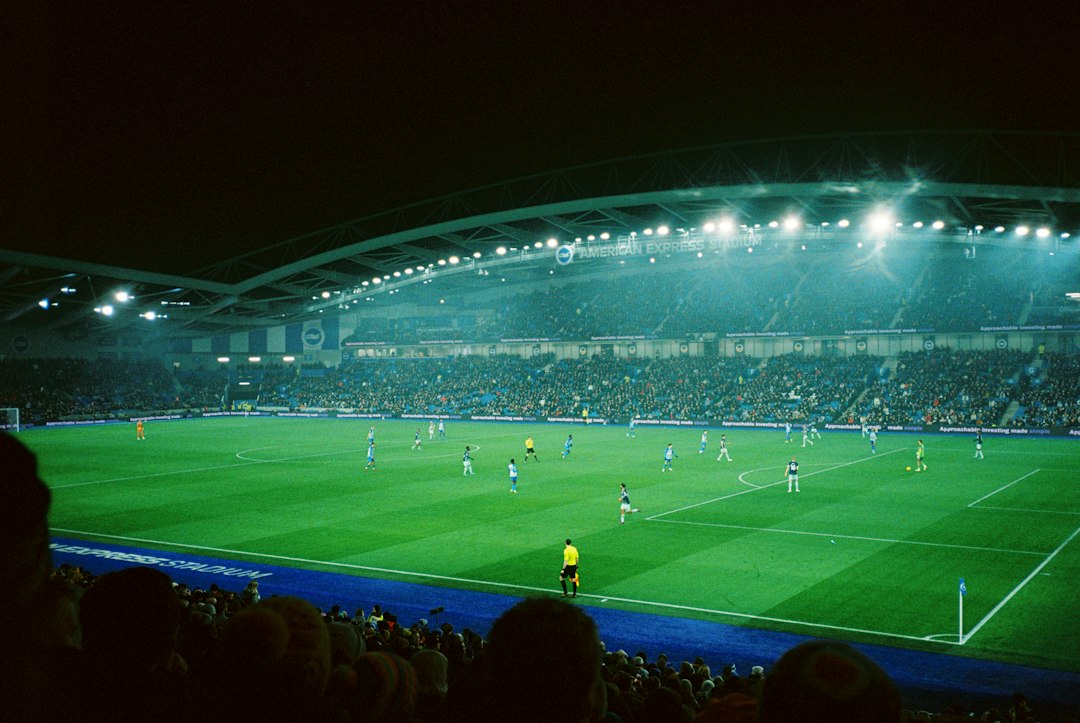




It happens somewhere in the second half — maybe when the camera cuts to a quarterback steadying himself before a critical snap, maybe when the crowd noise drops for half a second right before the ball moves.
You stop watching the game. You start remembering one.
Not a game on television. A game you played. That specific rush of NFL playoffs nostalgia isn't about longing for someone else's glory — it's your own nervous system reminding you that you've been in something like this. The cold air on the back of your neck. The particular weight of a moment that actually counted. The score, the sideline noise, the way your body felt before the whistle blew. January football has a way of pulling all of that back to the surface in about thirty seconds flat.
The best part? The lessons those moments forged in you didn't retire when you did.
What Playoff Football Triggers in the Athletes Who Played
There's a measurable difference between watching a high-stakes game as a fan and watching it as someone who has physically been in a version of that moment.
The fan watches the game. The former athlete inhabits it — tracking not just the play but the specific tension building in a defender's stance, the micro-pause before a receiver breaks his route, the way a lineman's weight shifts when he knows what's coming. It's a fluency built through thousands of repetitions, and it doesn't go dormant just because the playing days ended.
A 2017 review in Frontiers in Psychology on sports nostalgia found that former athletes engage with competitive events through what researchers called "participatory nostalgia" — not simply recalling a former self but briefly stepping back inside one. The emotional and physiological states tied to high-stakes athletic performance are encoded differently than passive memories. When the right stimulus arrives — a close score, a critical third down, a stadium at full volume — those states don't just resurface. They reactivate.


That's the specific mechanism behind what NFL playoffs nostalgia actually feels like. The playoffs don't just remind you of who you were. For about three hours, they briefly put you back in contact with that person.
The question worth asking when that happens: what did that version of you know that you've been underleveraging?
The Pressure Is the Point — NFL Playoffs Nostalgia and the Skill You Built
Every athlete who competed in a game that genuinely mattered learned the same thing eventually, usually through a moment that did not go well: pressure doesn't get smaller. You get more capable inside it.
That's not motivation-poster language. It's a specific, transferable skill — and the majority of former athletes carry it without having a name for it.
Consider the moments in your life since you stopped playing that required you to function under real pressure. The presentation where the stakes were high and the preparation time was short. The conversation where the outcome mattered and there was no script. The decision that had to be made quickly, with incomplete information, while other people were watching.
Where did your ability to stay operational in those moments come from?
It came from the field. From the locker room. From the third quarter of a game that mattered, when the margin wasn't where you needed it and the choice was between panic and presence — and someone had to choose presence, and that someone turned out to be you.
That's not a coincidence. That's a skill you built through consequence. And playoff football, every January, is the annual demonstration of what that skill looks like when it's fully developed.
Three Things Playoff Athletes Model — That You Already Lived
1. Preparation Is How You Purchase Calm
Watch an experienced playoff quarterback manage a two-minute drill and what looks like composure is actually the product of years of deliberate simulation. The calm isn't a personality trait. It's a form of equity — deposited in advance, drawn on under pressure.
In our experience covering athlete stories across sports, the former competitors who handle high-pressure professional environments most effectively aren't the ones who figured out how to manage stress after the fact. They're the ones who learned early that preparation is a preemptive act of confidence. You can't improvise genuine readiness. But if the readiness is real, the moment contracts around it.
Every practice you showed up for when motivation was absent was a deposit. When your playoffs arrived — and they do, they always do, they just don't always come with uniform numbers — you had capital to spend.
2. Dependency on Your Team Was Never a Weakness
The thing most former athletes miss most isn't the competition. It's the specific quality of reliance that competition creates — genuine, earned dependency on other people for outcomes that actually matter to you.
No playoff run is a solo achievement. The most dominant individual performance in a January game exists inside a larger structure of people who executed their assignments, made the call, ran the route, held the block. Knowing that your performance is inseparable from theirs — and acting accordingly — is one of the most sophisticated forms of professional intelligence there is.
Former athletes who build strong teams in business and in life frequently trace that capacity directly back to the locker room. Not as analogy. As origin. Learning to depend without surrendering accountability is a skill sport teaches through necessity, not theory.
3. The Regular-Season Losses Were the Real Curriculum
This one takes the longest to fully accept: the losses contributed more to the eventual playoff run than most of the wins did.
Every team that makes a deep January run carries a specific loss from earlier in the season — the game that exposed something, forced an adjustment, humbled a unit that had been operating on assumption rather than earned confidence. Those losses recalibrated the team. The teams that go furthest are almost always the ones that encountered genuine adversity early enough to do something about it.
Your career carries that same structure. The specific setback that looked like a wall but functioned as a correction. The moment that felt like an ending but was actually a realignment. Playoff-level performance — in sport or in anything else — is almost always downstream of a loss that hurt enough to change something.
Watching from the Sidelines — With Everything You Earned
Marcus T., 38, watches every playoff game from his living room in Atlanta, where he's spent eleven years coaching varsity football at the high school level. He played safety through two state championship runs in rural Mississippi — never extended past regional college ball, but played every snap like it was the only one that counted.
He says January football feels different now that he stands on the other side. "I don't watch technique anymore. I watch eyes. I watch what players do between plays — how they come back to the huddle after a bad one. Because I know exactly what's happening in their head, and the ones who are going to make plays are the ones who've already moved past the last down. They're already somewhere else. Already in the next one."
That's not a skill you pick up from the broadcast booth. You learn it by being in it — and then you spend the rest of your career recognizing it in the people around you who went through the same forge.
NFL Playoffs Nostalgia Is a Form of Real Inventory
There's a specific quality of attention that former athletes bring to playoff football. It isn't passive. It isn't just appreciation. It's comparative — not competitively, not bitterly, but with a kind of quiet recognition. I've been in something shaped like that.
That recognition is worth more than sentiment.
NFL playoffs nostalgia, at its best, isn't about wishing the clock ran backward. It's about understanding that what the game built in you is still active. Still yours. Still running in the background of every high-stakes moment you've navigated since the last time you wore a number.
The competitor who learned to narrow their focus under real pressure — still there.
The teammate who understood that individual accountability and collective dependency aren't opposites — still there.
The player who took a hard loss and came back to practice the next week instead of unraveling — still there.
The playoffs are the annual reminder. Four quarters, sudden death, everything on the line — and somewhere inside that, a signal that arrives for anyone who has ever played a game that mattered: you were forged in something like this, and it left a mark.
Three ways to work with that reminder instead of just feeling it
- Go specific, not general. Don't think about "the season" — think about one game, one play, one decision. The lesson lives in the specificity, not the summary.
- Name what that moment required of you. Focus, composure, trust in your teammates, recovery from an error — whatever it was, name it. That's a skill you possess, not just a memory you carry.
- Locate it in your current life. Where are you using that skill right now without calling it by name? Where could you be using it more deliberately?
The playoffs come once a year. So does this quality of reflection. It's worth more than a glance.
The Jersey Was Part of the Signal
The uniform was never just clothing. It was a specific, functional communication — to your opponents, to your teammates, and most importantly to your own nervous system. Putting it on was part of the ritual that told your body: this is real, this is now, we are doing this.
Former athletes who seek out a tribute to their playing days — a jersey in their colors, their name, their number — aren't reaching backward in a passive way. They're maintaining a physical connection to a version of themselves they spent years earning. That jersey, done in the style of your team and built around your identity on the field, represents something specific: the actual pressure you trained for, showed up for, and came through.
Your number wasn't assigned randomly. Your name meant something particular in that locker room. And every January, when playoff football brings all of it back to the surface, that specificity feels more alive than ever.
Your jersey is still out there waiting.
Design yours in minutes and see your name and number exactly the way you remember it.
Frequently Asked Questions
Why does watching the NFL playoffs trigger such strong memories for former athletes?
Former athletes engage with competitive sport on a different level than passive viewers. The emotional and physiological states tied to high-stakes athletic performance are encoded as procedural and emotional memory — meaning they don't just get recalled, they get reactivated. Playoff scenarios closely mirror the internal conditions athletes experienced during their own competitive play: the compressed time, the real consequence, the team dependency. The result is what researchers call participatory nostalgia — a brief, vivid re-inhabiting of a former competitive self, not simply a memory of one.
Does NFL playoffs nostalgia hit harder if you played at a high level?
The intensity of the competitive experience matters far more than the level. A player who went through a genuinely close regional championship at the high school level often carries that memory more vividly than someone who played college ball without ever experiencing real high-stakes pressure. What activates the nostalgia is the emotional specificity of the original experience — the real consequence, the real team dependency, the real performance demanded under pressure. Level of competition is secondary to the depth of those conditions.
How can former athletes reconnect with what they actually learned on the field?
The most direct route is specificity — returning to a particular game, a particular moment, a particular decision rather than engaging with sport as a general nostalgia category. The lessons from competitive play are stored in those specific moments: the third-and-long you converted, the coverage you held, the fourth-quarter adjustment that changed the outcome. Identifying those moments and asking what skill or quality they required gives former athletes a usable inventory of what they actually developed — and how it shows up in what they're doing now.
Does competitive athletic experience actually carry over into professional performance?
The relationship between high-stakes athletic experience and professional resilience is well-documented in both sports psychology and organizational research. The specific capacities most consistently identified include: maintaining functional performance during emotionally elevated situations, tolerating and learning from failure without identity collapse, and operating effectively at the intersection of individual accountability and team dependency. These qualities aren't guaranteed outcomes of playing sport — but athletes who competed in genuinely high-stakes environments, with real coaching and real consequences, tend to develop them in ways that transfer across contexts.
See also: what high school sports actually teach you that nothing else could | the psychology of athletic nostalgia and why those moments still matter | the bus ride home after a loss captures something no locker room speech ever could | why playing under the lights felt unlike anything else