

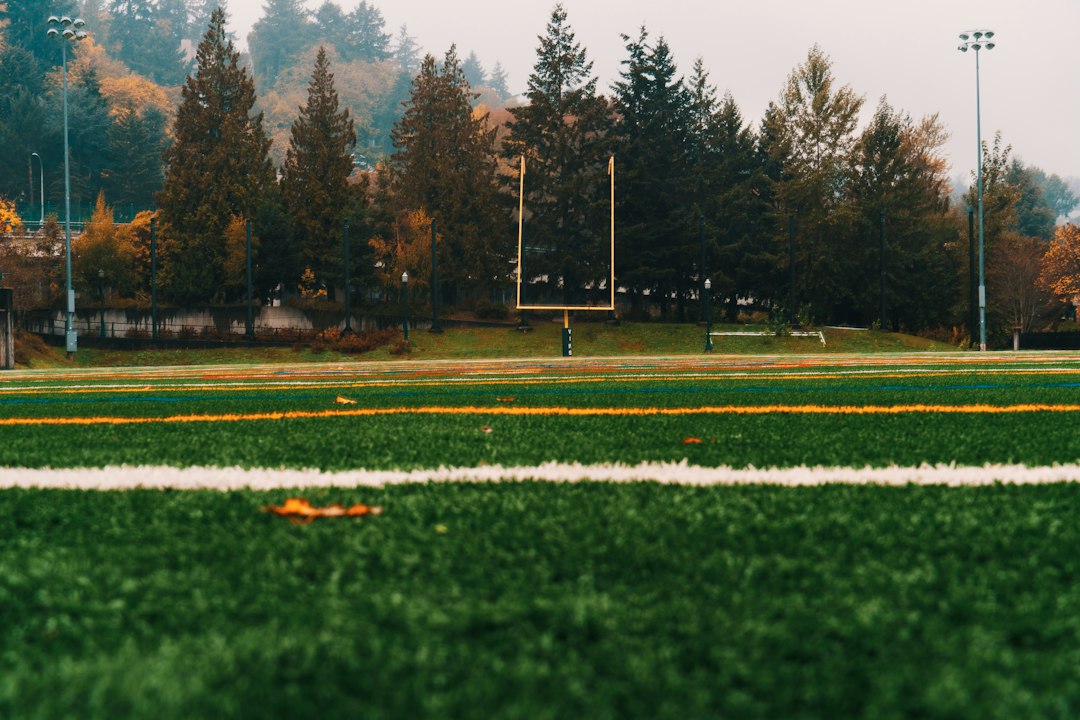




There's a smell that never leaves you.
Grass and mud and cool September air, the faint bite of athletic tape, the aluminum vibration of a bleacher row shaking under two hundred sneakers stomping in unison. If you played Oregon high school football — at any level, in any classification, in any decade — that smell is still somewhere in your memory, waiting for exactly this kind of Friday to drag it back to the surface.
On September 11, the Oregon high school football season pushed forward across all six classifications, and the scoreboards at SI High School Sports filled in from top to bottom — with the headline matchup of the evening being Westview taking on No. 1 West Linn.
Six classifications. Dozens of games. Hundreds of young men who, on that Friday night, knew exactly what it felt like to be the most present, most alive version of themselves.
For anyone who ever pulled on pads in this state, that knowledge isn't abstract. It's personal.
What Happened on September 11 Across Oregon High School Football
The September 11 slate was the kind of Friday that reminds you why the regular season carries as much weight as it does in Oregon prep football. West Linn entered the night as the top-ranked program in the state, and the matchup with Westview carried the particular charge of a game capable of reshaping the entire early-season conversation before October even arrives.
Across all six classifications — 6A, 5A, 4A, 3A, 2A, and 1A — results rolled in through the evening. That breadth is one of the things that genuinely separates Oregon prep football from what you find in a lot of other states. From the 6A programs in the Portland metro drawing college scouts to the 1A programs in small communities where the end zones are freshly painted and the entire town is in the stands, every classification carries its own legitimate stakes.


The top contest of the night — Westview versus West Linn — brought together two programs that carry real institutional weight. West Linn has built its reputation over years as one of the most consistently elite programs in the state. Westview is not the kind of program you look past. When these two share a field in September, the scoreboard matters, but so does the film. So does the Monday morning conversation in the weight room. So does what the players on both sidelines carry home with them.
That last part — the part that doesn't fit in a box score — is the whole point.
For Anyone Who Ever Played: This Is What a Friday Night in Oregon Actually Is
Every former player carries this knowledge, and every former player has tried at least once to hand it to someone who never suited up. You describe the locker room. You describe the noise of the crowd warming up. The person nods. They say it sounds intense. And you realize there is no language bridge wide enough to carry them from where they are to where you were.
The scoreboard shows numbers. What it doesn't show is the thirty minutes before kickoff.
It doesn't show the specific quality of silence that descends over a locker room when the music cuts and the head coach walks in. Not silence born from fear — something different. A collective internal gathering that happens without anyone calling for it. Players who were loose an hour earlier go quiet. The jokes stop landing because nobody's throwing them. The room compresses somehow, even though nothing has changed physically.
It doesn't show the first contact of warmups — not the first hit of the game, but the first crack of pads in pre-game drills when your body remembers exactly what it was built to do and something loosens behind your sternum.
It doesn't show what the field lights look like from the tunnel. That specific shade of artificial brightness falling on Pacific Northwest grass at eight o'clock on a September Friday. No photograph captures it accurately, because the photograph doesn't carry the crowd's noise or the temperature of the air or the weight of everything that led to this exact moment.
Every player who stepped onto an Oregon high school football field on September 11 lived inside that experience. Every former player reading this used to live inside it too.
Remember When the Friday Night Score Was Yours to Determine
Every former Oregon high school football player has a game that stays with them permanently. Not necessarily the championship. Not necessarily the biggest win on the schedule. The game where everything assembled correctly — where preparation and execution and the specific energy of that particular Friday aligned into something that felt, in the moment, inevitable.
For some former players, that game was a decisive victory where the second quarter erased any doubt and the rest of the night became a kind of confirmation. For some, it was a loss — the kind where the final whistle found you leaving everything on the field, and the dignity of that effort outlasted the sting of the score by years.
Marcus T., 34, played linebacker for a 3A program in southern Oregon. He talks about a specific October game during his junior year — temperature dropping through the second half, an opposing running back cutting toward a gap Marcus had spent the entire week in practice learning to close. He got there in time. "I remember thinking, 'This is why,'" he says. "That's it. Just: this is why." His game jersey hangs framed in his home office — not because his team won that night, but because the jersey is the physical proof the experience happened.
That's the thing about a Friday night under the lights in Oregon high school football. The scoreboard belongs to the record books. The experience belongs to the players.
What Six Classifications Actually Mean to the People Inside Them
There's a recurring debate in Oregon prep football circles — usually some version of 6A fans looking past the smaller divisions, or 1A advocates making the case that their brand of football is more community-rooted and less beholden to recruiting pipelines. Both arguments contain real observations. Neither one is the full picture.
What's actually true is that every classification generates its own version of the Friday night experience, and none of them is a diminished version of the others.
The 6A experience at a program like West Linn or Westview means college evaluators in the bleachers, film sessions that extend past midnight, and the specific pressure of knowing your performance is being assessed on multiple simultaneous dimensions. That pressure is real and formative.
The 1A experience at a small-town Oregon program — where the roster might carry twenty-two players total and every starter plays both ways — produces something different and equally real. The community investment is absolute. The Friday night game is the Friday night event. Former 1A players describe it the same way across generations: the whole town came. Not most of it. All of it.
What unifies every classification on a night like September 11 is the structure of the experience itself. The preparation cycle. The execution under pressure. The final whistle. And the long moment that follows — win or lose — when you're still standing on the field and the lights haven't gone dark yet and you know with unusual clarity exactly where you are and what this moment is.
Those moments accumulate. Years later, they're what's left.
West Linn, Westview, and the Games That Define What a Season Becomes
The significance of West Linn's No. 1 ranking heading into September 11 goes beyond the number itself. Rankings change the texture of a game in ways that are hard to describe from outside the locker room. When you play the top team in the state — or when you are the top team in the state facing a program with something to prove — each possession carries an additional layer of weight. Former players who've been in that situation describe the week leading up to it as operating at a different frequency than a normal game week.
The film sessions feel more consequential. The walk-throughs have a different kind of attention. The specific adjustments your coaching staff makes carry more gravity when you know the opponent on the other side of them is ranked first.
Westview players who dressed out on September 11 understood that context before they ever set foot on the field. West Linn players understood they were the measuring stick. Both programs added a chapter to their season's story that Friday. Those stories are still being written for the current rosters.
For former players, the story is finished. The Fridays are done. What remains is the memory — and, for those who want something tangible to hold onto, the jersey.
Your jersey is still out there waiting.
Design yours in minutes and see your name and number exactly the way you remember it — a tribute to the program, the classification, and the Friday nights that shaped you.
Frequently Asked Questions
What were the top games on the Oregon high school football schedule for September 11?
The featured matchup on September 11 was Westview against No. 1 West Linn, which drew statewide attention as one of the most significant early-season contests in the 6A classification. Results for all six classifications — 6A, 5A, 4A, 3A, 2A, and 1A — were tracked through the evening, with full scoreboards available through SI High School Sports.
How does Oregon's six-classification high school football system work?
Oregon organizes high school football into six classifications based primarily on school enrollment. Larger metro-area schools compete in 6A, while smaller and rural programs compete in 5A through 1A. Each classification runs its own complete postseason, producing a separate state champion. The structure ensures schools compete against programs of comparable size and roster depth, though non-league scheduling occasionally brings classifications together and produces some of the most memorable early-season results.
Where can I find live scores and results for Oregon high school football?
Live and final scores for Oregon high school football are tracked through several outlets during the regular season. SI High School Sports maintains real-time scoreboards for major Friday night slates across all six classifications. Local outlets including OregonLive and regional television affiliates also provide score tracking throughout the regular season and into the playoffs.
Why do Oregon high school football Friday nights stay with former players for so long?
The combination of peak physical preparation, high community stakes, and the compressed emotional intensity of a single game creates memories that sports psychology research consistently identifies as among the most durable athletes carry through their lives. The specificity of the experience — the locker room, the lights, the crowd, the final whistle — gives it a sensory completeness that most adult experiences don't match. Former players aren't being sentimental when they say those nights never fully leave. The neuroscience of emotionally significant memory formation supports exactly that.
Can I get a custom jersey inspired by my Oregon high school football uniform?
Yes. iPlayedFor creates custom jerseys designed as tributes to the programs and eras that shaped former players — built in the style of the uniform you wore, with your name, your number, and the color combinations you remember. Former players use them as display pieces, gifts for longtime teammates, and wearable reminders of the Friday nights that mattered most. Start designing yours at iPlayedFor.
See also: what high school football meant to the athletes who played it | what playing under the Friday night lights actually felt like | how football-obsessed Oregon and other states really are | what high school sports teach you that nothing else could