

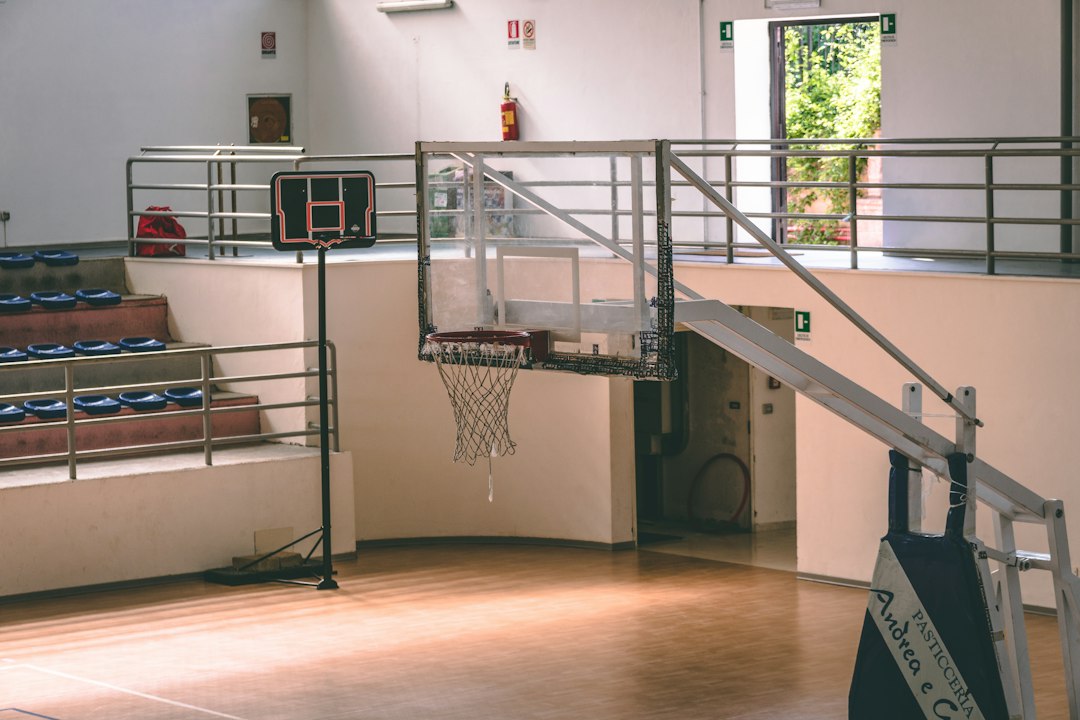




You can still hear it, can't you? The squeak of rubber on a hardwood floor. The thud of a ball against a backboard in a half-empty gym. The way a whole building seemed to inhale right before a free throw. If you played high school basketball in Indiana, that sound isn't a memory. It's a room you can walk back into anytime you close your eyes.
Here's what outsiders never quite get. In most places, a basketball game is something that happens on a weeknight. In Indiana, it was the weather. It was the main subject at the barbershop, the diner, the church parking lot, the grocery checkout. When you walked through town in your team jacket, people knew your name, your number, and how many points you put up last Friday.
This piece is for the people who lived that. We'll talk about why high school basketball Indiana style carries a weight almost nowhere else can match, what it did to the people who played inside it, and why, decades later, the feeling hasn't faded one bit.
High School Basketball Indiana Style: The Gym That Held the Whole Town
Walk into an Indiana gymnasium and you notice the scale before you notice anything else. Some of the largest high school gyms in the country sit in towns where the population couldn't fill half the seats. That's no accident. Those buildings were raised on a belief: the team belongs to everybody, so everybody needs a seat.
If you played, you know the layout by heart. The visitors' bench that always sat a little too close to the student section. The wall pads that were never quite thick enough. The scoreboard with one bulb that flickered in the fourth quarter. The smell of floor wax mixed with popcorn and radiator heat. You could pick that smell out of a hundred others, blindfolded, thirty years later.
Why the Size of the Building Mattered
A gym that seats thousands in a town of a few thousand tells you something about priorities. In our experience talking with former players, the first thing they mention isn't a score or a stat. It's the crowd. "The whole town was there" comes up again and again, and it's rarely an exaggeration.


That crowd changed how you played. You weren't performing for scouts or highlight reels. You were playing for your English teacher in row twelve, your grandfather in the corner with his arms crossed, and the old guy who'd been to every home game since 1962 and still kept the program from your freshman year.
The Weight of Being Watched by People Who Knew You
Playing in front of strangers is one kind of pressure. Playing in front of people who've known you since you were in diapers is another thing entirely. Every missed rotation, every turnover, every loose-ball dive was seen by someone who'd talk about it Saturday morning.
Somehow, that made you better. It held you accountable in a way no coach's speech ever could.
How Hoosier Hysteria Became a Way of Life
There's a phrase for all of this: Hoosier Hysteria. It began as a description of the tournament fever that swept Indiana every March, and it grew into shorthand for the whole culture of the game here.
For a long stretch of its history, Indiana ran a single-class state tournament. Every school, tiny or enormous, entered the same bracket. A rural school with a few dozen boys in the senior class and a big-city powerhouse could, on the right night, meet in the same arena with the same shot at the same trophy. According to the Indiana High School Athletic Association, that single-class tradition ran for decades before the state moved to a class system, and it left a mythology that outlived the format. The underdog wasn't a cliché here. The underdog was a real possibility every single March.
The Small-Town Dream
If you came from a small school, that tournament told you something your whole childhood: you belong on this floor. Nobody handed you a lower bracket or a consolation trophy. You walked into the same arena as everyone else, and you had a chance.
Even after the format changed, that spirit never left the people who grew up inside it. Ask a former player from a small Indiana school about the first time they stepped into a tournament game, and watch what happens to their face. Something lights up behind the eyes. They're seventeen again.
March Was a Season of Its Own
Football has autumn. Baseball has summer. In Indiana, basketball had winter, and winter had its own rituals. The pep sessions where the whole school packed the gym. The signs taped to lockers. The painted faces, the matching shirts, the cars lined up behind the team bus as it left town for a sectional game.
If you played, you know this feeling: walking out of the school toward the bus while the entire student body clapped. You were a teenager. You didn't know how to hold that moment. You just knew your chest felt too small for it.
What Playing Here Taught You Without Anyone Saying It
Here's something we hear from former Indiana players constantly, and it's the part nobody puts on a plaque. The game taught you things that had nothing to do with basketball.
Fundamentals as a Form of Respect
Indiana basketball culture has long been tied to fundamentals: the bounce pass, the boxed-out rebound, the screen set properly, the free throw practiced until it was boring. Coaches here didn't just teach you to score. They taught you the right way to do small things, over and over, until doing them wrong felt physically uncomfortable.
That habit followed you out of the gym. You probably still square your shoulders before a hard conversation. You still do the unglamorous prep work before something matters. The way you showed up for practice at 6 a.m. in a freezing gym built a version of you that still shows up for things.
The Slow Education of Showing Up
Nobody applauds the drill. Nobody films the sprint line. But the kid who ran the line hardest on Tuesday was usually the kid who got the open look on Friday. That lesson didn't arrive as a speech. It arrived as a thousand ordinary Tuesdays.
A Moment Every Player Remembers
Marcus T., 52, played guard for a small-town team in southern Indiana in the late '80s. He remembers a game he rarely brings up, because he didn't score a single point. His job that night was to guard the other team's best shooter for thirty-two minutes, and he did it so well the kid finished with four points. The box score gave him nothing. Afterward, an old man in the stands, a total stranger, shook his hand at the door and said, "I saw what you did." Marcus still thinks about that handshake more than any game he ever scored in.
That's the Indiana way in one story. The game saw everything. The people watching knew what they were looking at.
The Rivalries That Never Really Ended
Every Indiana player has a rivalry story, and most of them involve a town twelve miles away.
If you played, you know the feeling of walking into their gym. The student section seemed louder. The rims felt tighter. The bleachers seemed closer to the floor. You'd spent the whole week hearing about it at school, in the hallways, at the gas station, from your own parents. A rivalry game wasn't something you played. It was something you carried around for seven days before tipoff.
Why These Games Lived So Long in Memory
Ask a former player about a rivalry game and you won't get stats. You'll get a scene. A buzzer-beater, a missed layup, a technical foul, a moment in the fourth quarter when the whole building went silent. The details sharpen with age instead of fading, because those games were never really about the score. They were about the people you couldn't stand to lose in front of.
The Strange Peace That Comes Later
Here's the part that surprises people. Decades on, former rivals often become something close to old friends. You run into the guy who guarded you at a hardware store or a wedding or a funeral, and within thirty seconds you're re-living a Tuesday night game from 1991 like it happened last week. The rivalry gave you a shared language nothing else could.
The Women Who Built Their Own Legacy
Any honest conversation about the game in this state has to include the girls' side, which carries its own proud, hard-won history. For years, girls' basketball in Indiana fought for the same gyms, the same crowds, and the same respect that boys' teams took for granted. The women who played in those years know exactly what it cost to earn a full gym on a Friday night.
If you played on a girls' team, you remember it. Maybe you remember being scheduled for the early game, hoping the crowd would arrive in time. Maybe you remember the first year the stands actually filled for you. Those moments aren't small. They're the foundation every girl who followed was able to stand on.
Pride That Was Earned Twice
Former girls' players often describe a double pride: the pride of playing the game, and the pride of helping prove it deserved the spotlight. Both are real. Both belong in the story of this state's basketball identity.
Why the Feeling Doesn't Fade
Here's what we notice when we talk with people who played: most can recall their high school basketball experience with a clarity that surprises even them. They remember their jersey number. They remember who sat next to them on the bench. They remember the exact color of the warm-up pants.
Our team has a theory about why. It isn't just nostalgia. Those years happened at the exact age when you were still figuring out who you were. The game became part of the foundation. It wasn't something you did. It was something you were, in the stretch of life when identity was still wet cement.
The Jersey as a Container for Everything
If you played, you know what a jersey does. It isn't a piece of clothing. It's a container. Put it on and you became a particular version of yourself: someone with a number, a role, a team behind you. Take it off and you carried that version home inside your chest.
That's why so many former players hold onto theirs, or wish they had. Somewhere between graduation and the first apartment and the third move and the garage cleanout, a lot of those jerseys disappeared. A mother donated a box. A move went sideways. A basement flooded. Decades later, plenty of former players find themselves quietly wishing they could hold that fabric one more time.
What a Name and Number Actually Mean
Your name stitched above your number was never just an identifier. It was a claim. It said: I belonged to something. I was part of this. In a state where the game meant what it meant, that claim carried more weight than most.
Elena R., 47, played forward for a girls' team in northern Indiana in the early '90s. She lost her jersey in a basement flood years ago. When her daughter made the varsity team at the same school, Elena found herself in the stands feeling something she couldn't quite name. It wasn't jealousy. It was a longing for her own seventeen-year-old self, the one with her name and number on her back. She had a custom jersey made in the style of the one she wore, not to wear out, just to hang on her wall where she'd see it every morning.
What the Game Gave You That You Still Carry
Strip away the scores and the trophies and ask what's left. The things that actually shaped a life.
- A sense of belonging that didn't depend on being the star. The sixth man, the practice player, the kid who hustled for rebounds: everyone had a place.
- A shared language with strangers. Mention your high school and your number to another Hoosier and watch the conversation open up.
- A standard for effort. Somewhere inside you, there's still a voice that says run the line harder.
- A memory of being part of something bigger than yourself. Not many experiences hand you that at seventeen.
The Quiet Return Trips
Plenty of former players go back, quietly. Not for a reunion, not for an event. Just to drive past the gym on a winter evening and see the lights on. Maybe the parking lot is full. Maybe it's a junior varsity game on a Tuesday. It doesn't matter. Sitting in the car with the engine running, watching the building glow, you feel something that doesn't fit into a sentence.
If you've done that, you already understand everything this piece is trying to say.
How to Keep the Memory Close
Memories fade at the edges unless we give them something to hold. Here are a few things we've seen former players do that genuinely help:
- Write down the specific details. Your number, your coach's catchphrases, the smell of the locker room, the song that played during warm-ups. These details disappear faster than you'd expect.
- Find your teammates. Even one phone call can restart a decade of shared stories.
- Hold something physical. A photo, a ticket stub, a ball, a jersey. Objects anchor memory in a way thinking alone cannot.
- Tell the stories out loud. Share them with your kids, your friends, your spouse. Stories told aloud live longer than stories kept silent.
Of these, the physical object is often the most powerful. There's something about holding the actual fabric, seeing your own name and number the way they used to look, that collapses decades in a second.
Your jersey is still out there waiting.
Design yours in minutes and see your name and number exactly the way you remember it.
Frequently Asked Questions
Why does high school basketball mean so much in Indiana?
It comes down to history, structure, and community. For many decades, Indiana held a single-class state tournament in which every school, large or small, competed in the same bracket, which built a deep belief that any town could win. Add enormous gymnasiums, tight-knit small communities, and a culture that treated the local team as shared property, and the game became woven into everyday identity in a way few other states match.
What is Hoosier Hysteria?
Hoosier Hysteria is the nickname for the basketball fever that sweeps Indiana, especially around tournament season in late winter. It describes the packed gyms, the community pep rallies, the road-trip caravans, and the way entire towns seem to organize themselves around a team's success. For people who grew up there, it's less a slogan and more a lived experience.
Did Indiana really have a single-class tournament?
Yes. For a long stretch of its history, Indiana ran one state tournament open to every school regardless of enrollment size. A tiny rural school could, in theory, meet a much larger school for the championship. The state later moved to a class-based system, but the single-class era left a lasting mark on the state's basketball mythology and on how generations of players think about their own teams.
Why do so many former Indiana players remember their high school games so vividly?
Those years happened at a formative age, when identity was still taking shape, and the game was often the center of a player's social world. Add the intensity of community attention, the rivalries, and the ritual of game nights, and the experience sinks deeper into memory than most other high school activities. Many players say specific details, like a locker room smell or a bus ride, stay sharp for decades.
What can I do if I no longer have my high school basketball jersey?
You're far from alone. Jerseys disappear through moves, donations, and basement cleanouts all the time. Many former players choose to have a custom jersey made with their own name and number as a keepsake, something to display on a wall, wear on game days, or hand down to a kid. It won't be the original, but it can bring back the feeling of seeing your name and number the way you remember.
Is girls' basketball part of the Indiana tradition too?
Absolutely. Girls' basketball in Indiana has its own proud history, including years of players earning their place in packed gyms and building the foundation for the athletes who followed. The pride, the rivalries, and the community connection are just as real on the girls' side, and many former players describe a double pride in both the game and in helping earn it the spotlight it deserves.
See also: Friday night lights were real | why high school sports matter to adults long after graduation | the emotion of senior night | the 10 most football-crazy states in America | what high school sports taught you that nothing else could